ella

Thursday, 6 February 2014

CHAPTER 8 : ACCESSING ORGANIZATIONAL INFORMATION - DATA WAREHOUSE

Data warehouse fundamentals

-Data warehouse - a logical collection of information-gathered from many different operational database- that supports business analysis activities and decision-making tasks.

-Primary purpose - to aggregate information throughout an organization into a single repository in such way that employees can make decisions and undertake business analysis activities.

-Extraction, transformation and loading (ETL) - a process that extracts information from internal and external database, transforms the information using a common set of enterprise definitions, and loads the information into a data warehouse.

-Data warehouse- then send subsets of the information to data mart.

-Data mart - contain the subsets of data warehouse information.


MULTIDIMENSIONAL ANALYSIS AND DATA MINING
cube- the common term for the representation of multi dimensional databases.


data mining - process of analyzing data to extract information not offered by the raw data alone.
data-mining tools - variety of techniques to find patterns and relationship in large volumes of information and infer rules from them that predict future behaviour decision making.

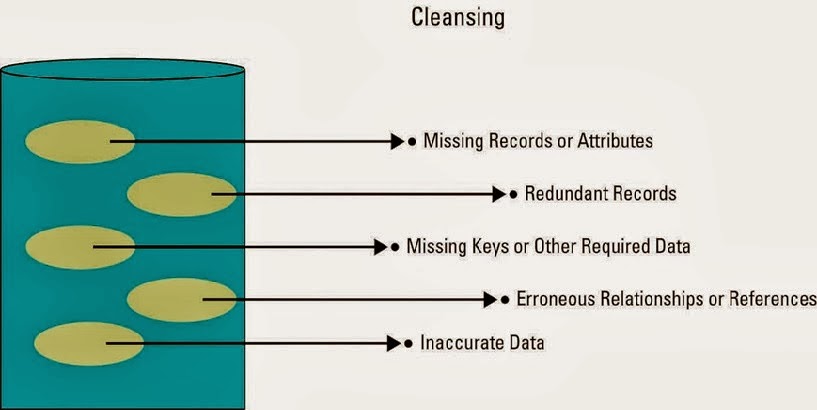
INFORMATION CLEANSING AND SCRUBBING

                                                -contact information in operational system

                                           -standardizing customer name from operational systems

                                                         -information cleansing activities


                                                       -accurate and complete information


BUSINESS INTELLIGENCE

-application and technologies that are used to gather, provide access to and analyze data and information to support decision-making efforts.specifically :-


  • collecting information.
  • discerning patterns and meaning in the information.
  • responding to the resultant information.


CHAPTER 7 : STORING ORGANIZATIONAL INFORMATION-DATABASES

Database - maintains information about various types of objects (inventory), events (transactions), people (employees), and places (warehouses).
Hierarchical database model - information is organized into a tree-like structure that allows repeating information using parent/child relationships in such a way that it cannot have too many relationships.
Network database model - is a flexible way of representing objects and their relationships.
Relational database model - type of database that stores information in the form of logically related two-dimensional tables.

This picture below show the hierarchical, network and relational structure :-


ENTITIES AND ATTRIBUTES
entity - the relational database ,model is a person, place, thing model is a person, place, thing, transaction, or event about which information is stored.
attributes - fields or columns, are characteristics or properties of an entity class.

KEYS AND ATTRIBUTES
primary key - group and fields that uniquely identifies a given entity in a table.
foreign key -  the relational database model is a primary key of one table that appears as an attribute in another table and acts to provide a logical relationship between two tables.


RELATIONAL DATABASE ADVANTAGES
-Increased flexibility
-Increased scalability and performance
-Reduced information redundancy
-Increased information integrity (quality)
-Increased information security

#INCREASED FLEXIBILITY
Databases tend to mirror business structures and a good database can handle changes quickly and easily.
physical view - information deals with the physical storage of information on a storage device such as a hard disc.
logical view - information focuses on how users logically access information to meet their particular business needs.

#INCREASED SCALABILITY AND PERFORMANCE
scalability - how well a system can adapt to increased demands.
performance - how quickly system performs a certain process or transaction.

#REDUCED INFORMATION REDUNDANCY
redundancy - duplication of information, or storing the same information in multiple places.

#INCREASED INFORMATION INTEGRITY (QUALITY)
information integrity - measure of the quality of information.
relational integrity constraints - rules that enforce basic and fundamental information- based constraints.
business-critical integrity constraints - enforce business rules vital to an organization's success an often require more insight and knowledge than relational integrity constraints.

#BUSINESS INFORMATION SECURITY
any asset that the organization must protect its information from unauthorized users or misuse.

DATABASE MANAGEMENT SYSTEMS (DBMS)
-software through which users and application programs interact with a database.


DATA DRIVEN WEBSITE
-interactive website kept constantly updated and relevant to the needs of its customers through the use of a database.


INTEGRATING INFORMATION AMONG MULTIPLE DATABASES
integration - allows separate systems to communicate directly with each other.
forward integration - takes information entered into a given system and sends it automatically to all downstream systems and processes.
backward integration - takes information entered into a given systems and sends it automatically to all upstream systems and processes.

Thursday, 16 January 2014

Norzulaiha Bt. Alias
Noor Asniza Bt. Asmaddin
Ayuliza Bt. Kasim
Nurul Aisyah Bt. Ahmanul
Nur Atila Bt. Abdul Rahman
Putri Azizuhainee Bt. Mohd. Khalid

Question :
We know that people use information technology to work with information. Knowing this, how could these types of errors occur? What could happen if you decided to use Facebook to collect information intelligence for a research paper? What could Facebook do to help prevent these types of errors?

Here are some references to determine whether the information obtain is a good or bad; 


Problems that may occur:

Facebook is a website that is generally open to all.  The information can be easily falsify and does not need to be filtered. Thus, why the information is not credible for the use of a research. The information obtain may not be true or valid and may not be based on facts. Furthermore, the information at facebook may be biased as it is based on ones opinion and perception. Lastly, we have no way to insure that the information that is posted on facebook is valid as for we do not know the sources of information and its credibility.

Prevention that Facebook may do to prevent these problems:
Facebook should filter the information posted on their website or increase its security by valuating its information and sources.

Thursday, 9 January 2014

CHAPTER 6 : VALUING ORGANIZATIONAL INFORMATION.

ORGANIZATIONAL INFORMATION

Organizational information comes at different levels and in different formats and "granularities".
  • Information granularity - the extent of detail within the information (fine and detailed or coarse) and abstract.The organizational must know what kind of information that they want to know. We must ensure the information gives the best quality for that organizational itself.
  • Employees must be able to differentiate the levels of the information, formats and granularities of information when making a decision. If the employees can knows how to use the information with different levels of information or format then, the information can be a values to the sender or receiver of the information.
  • Successfully collecting, compiling, sorting and finally analyzing information from multiple levels, in varied formats, exhibiting different granularity can provide tremendous insight how an organization is performing.

                                          figure 6.1 show the levels, formats and granularities of                                                                                   organizational information.
THE VALUE OF TRANSACTIONAL AND ANALYTICAL INFORMATION.
  • Transactional information - encompases all of the information contained within a single business process or unit of work, and its primary purpose is to support the performing of daily operational tasks.For example is include withdrawing cash from ATM.
  • Analytically information - encompasses all organizational information, and its primary purpose is to support the performing of managerial analysis tasks. Organizations capture and store transactional informations in databases, and use it when performing operational tasks and repetitive decissions such as analyzing daily reports and production schedules.

POOR INFORMATION
- happened when some of the information are not completed or missing and this make the information are not accurate, inability to track customers. With the poor information, its difficult for he organizational to make aright decissions because of poor information happened.

HIGH INFORMATION
-can significantly improve the chances of making a good decision and directly increase an organization's bottom line.So, if the organizational have ahigh quality of information but the people in the organizational do not use the information accurately, it will be nothing.


CHAPTER 5 :  ORGANIZATIONAL STRUCTURES THAT SUPPORT STRATEGIC INITIATIVES 

ORGANIZATIONAL STRUCTURES 


  • Employees across the organization must work closely together to develop strategic initiatives that create competitive advantages.
  • Understanding the basic structure of a typical IT department including titles, roles, and responsibilities will help an organization build a cohesive enterprise wide team.
IT ROLES AND RESPONSIBILITIES

  • CEO (Chief Executive Officer)is the highest-ranking corporate officer (executive) or administrator in charge of total management of an organization.
  • CIO (Chief Information Officer) - responsible overseeing all uses of information technology and and ensuring the strategic alignment of IT with business goals and objectives.
  • CTO (Chief Technology Officer) - responsible for ensuring the throughput, speed, accuracy, availability, reliability of an organization's information technology.
  • CSO (Chief Security Officer) - responsible for ensuring the security of IT systems and developing strategies and IT safeguards against attacks from hackers and viruses.
  • CPO (Chief Privacy Officer) - responsible for ensuring the ethical and legal use of information within an organization.
  • CKO (Chief Knowledge Officer) - responsible for collecting, maintaining and distributing the organization's knowledge.

                                          figure 4.1 show the skills pivotal for success in Executive It
                                          Roles.

THE GAP BETWEEN BUSINESS PERSONNEL AND IT PERSONNEL

  • Business Personnel - possess expertise in functional areas such as marketing, accounting, sales.
  • IT Personnel - have the technological expertise.
  • Their gaps is business personnel have their own vocabularies based on their experience and expertise.IT Personnel have their own vocabularies consisting of acronyms and technical terms.
ETHICS AND SECURITY

  • ETHICS - the principles and standards that guide our behaviour toward other people.
  • PRIVACY - the right to be left alone when you want to be, to have control over your own personal possessions, and to not be observed without your consent.
 

Wednesday, 8 January 2014

Chapter 4 – Measuring the Success of Strategic Initiatives

MEASURING INFORMATION TECHNOLOGY’S SUCCESS
  • -          Key performance indicator – measures that are tied to business drivers
  • -          Metrics are detailed measures that feed KPIs
  • -          Performance metrics fall into the nebulous area of business intelligence that is neither technology, nor business centered, but requires input from both IT and business professionals

EFFICIENCY AND EFFECTIVENESS
  • -          Efficiency IT metric – measures the performance of the IT system itself including throughput, speed, and availability
  • -          Effectiveness IT metric – measures the impact IT has on business processes and activities including customer satisfaction, conversion rates, and sell-through increases

BENCHMARKING – BASELINE METRICS
  • -          Regardless of what is measured, how it is measured, and whether it is for the sake of efficiency or effectiveness, there must be benchmarks – baseline values the system seeks to attain
  • -          Benchmarking – a process of continuously measuring system results, comparing those results to optimal system performance (benchmark values), and identifying steps and producers to improve system performance


-          Comparing efficiency IT and effectiveness IT metrics for the government initiatives 

THE INTERRELATIONSHIPS OF EFFICIENCY AND EFFECTIVESS IT METRICS

-          Common types of efficiency IT metrics


Efficiency IT Metrics
Throughput
The amount of information that can travel through a system at any point.
Transaction speed
The amount of time a system takes to perform a transaction.
System availability
The number of hours at system is available for users.
Information accuracy
The extent to which a system generates the correct results when executing the same transaction numerous times.
Web traffic
Includes a host of benchmarks such as the number of page views, the number of unique visitors, and the average time spent viewing a web page.
Response time
The time it takes to respond to user interactions such as a mouse click.

-          Effectiveness IT metrics focus on an organization’s goals, strategies, and objectives and include…


Effectiveness IT Metrics
Usability
The ease with which people perform transactions and/or find information. A popular usability metric on the Internet is degrees of freedom, which measures the number of clicks required to find desired information.
Customers satisfaction
Measured by such benchmarks as satisfaction surveys, percentage of existing customers retained, and increases in revenue dollars per customer.
Conversion rates
The number of customers an organization “touches” for the first time and persuades to purchase its products or services. This is a popular metric for evaluating the effectiveness of banner, pop-up, and pop-under ads on the Internet.
Financial
Such as return on investment (the earning power of an organization’s assets), cost-benefit analysis (the comparison of projected revenues and costs including development, maintenance, fixed and variable), and break-even analysis (the point at which content revenues equal ongoing costs).

-          Security is an issue for any organization offering products or services over the Internet.
-          It is inefficient for an organization to implement Internet security, since it slows down processing.
·         However, to be effective it must implement Internet security.
·         Secure Internet connections must offer encryption and Secure Sockets Layers (SSL denoted by the lock symbol in the lower right corner of browser)

-          Interrelationships between efficiency and effectiveness. 

METRICS FOR STRATEGIC INITIATIVES

-          Metrics for measuring and managing strategic initiatives include;
·         Website metrics.
·         Supply chain management (SCM) metrics
·         Customer relationship management (CRM) metrics
·         Business process reengineering (BPR) metrics
·         Enterprise resource planning (ERP) metrics 


WEBSITE METRICS

SUPPLY CHAIN MANAGEMENT METRICS 

CUSTOMER RELATIONSHIP MANAGEMENT METRICS
BPR and ERP Metrics

-          The balanced scorecard enables organizations to measure and manage strategic initiatives. 

Wednesday, 18 December 2013

   Chapter 3 is about Strategic Initiatives for Implementing Competitive Advantages. This chapter introduces high-profile strategic initiatives that an organization can undertake to help it gain competitive advantage and business efficiencies. There are 4 strategic initiatives that the management can use which is:-
i)              Supply Chain Management
ii)             Customer Relationship Management
iii)            Business Process Reengineering
iv)           Enterprise Resource Planning

  Supply Chain Management  (SCM) is management of information flows between and among stages in a supply chain to maximize total supply chain effectiveness and profitability.


Four basic components of supply :-
# supply chain strategy – the strategy for managing all the resources required to meet customer demand for all products and services.                                                                                                                                -for example: the company wants to sell “tudung fareeda” , then they should find all the resources such the cloth and the colour of cloth to fulfil the customer’s demand.
# supply chain partners – the partners chosen to deliver finished products, raw materials, and services including pricing, delivery, and payment processes along with partner relationship monitoring metrics.                                                                                                                                                     
-for example to make the hijab maybe some supplier just supply the thread and another supplier can supply cloth, so that they can combined their supplied and became a partner.
# supply chain operation – the schedule for production activities including testing, packaging, and preparation for delivery. Measurements for this component include productivity and quality.                           
-for example to produce the product, the company should have their own schedule to make the process of production can run smoothly.
# supply chain logistics – the product delivery processes and elements including orders, warehouses, carriers, defective product returns and invoicing.                                                          -this part is for all the product delivery such the transportation and to where the product has keep.
Effective and efficient supply chain management systems can enable an organization to:
Decrease


Organization’s Supply Chain

Supplier power
Buyer supplier
Threat of substitute products or services
Threat of new entrants
Increase

The buyer power decrease when they have less choices to buy a products or services. So, it can make a supplier power increase. Then, the threat of substitute products or services and threat of new entrants also decrease because the product that they sell is less competitors.

Customer Relationship Management (CRM) involves managing all aspects of customer’s relationship with an organization to increase customer loyalty and retention and an organization’s profitability.
CRM allows an organization to gain customer’s shopping and buying behaviours to develop and implement enterprise wide strategy.
CRM is occurs anywhere such as Aeon shopping centre, Perodua and etc.                                                              For example is someone has send their car to Perodua to service it, then after finish and he already back home. Then the Perodua call him to get the feedback from their services.
CRM allows us to communicate effectively with each customer and understand customer product and sevice.


CRM strategy:-
According to Michael Boyd director at Eddied Bauer, said that CRM is a business strategy to try to optimize profitability, revenue, and satisfaction at an individual customer level.
CRM is not just technology , but also a strategy that an organization must embrace on an enterprise level.
CRM system also allos an organization to treat customers as individuals, gaining important insights into their buying preferences and behavior and leading to increase sales, greater profitability, and higher rate of customers loyalty.


Business Process Reengineering (BPR) :-
Business process is a standardized set of activities that accomplish a specific task, such as processing a customer’s order.
Business Process Reengineering (BPR) is the analysis and redesign of workflow within and between enterprises.


Organize around outcome not task


7
PRINCIPLE
Treat geographically dispersed resources as though they were centralized
Identify all the organization’s processes and prioritize them in order of redesign urgency
Link parallel activities in the workflow instead of just integrating their results.
Put the decision point where the is performed, and bulid control into the process.
Integrate information processing work into the real work that produces the information
Capture information once and at the source.


Finding Opportunity Using BPR

Companies frequently strive to improve their business processes by performing tasks faster, cheaper, and better. A company could improve the way that it travels the road by moving from foot to horse and then from horse to car.
Creating values for the customers is the leading factor for instituling BPR, and information technology often plays an important enabling role.

Pitfalls Of BPR
One hazard of BPR is that the company becomes a wrapped up in fighting its own demons that it fails to keep up with its competitors in offering new products or services.

4) Enterprise Resource Planning


-ERP integrates all departments and functions throughout an organization into a single IT system.
-ERP system helps an organization to obtain operational efficiencies, lower costs, improve supplier and customer relations, and increase revenues and market share.
-The heart of an ERP system is a central database information from and feeds information into all the ERP system's individual application components (called modules), supporting diverse business function such as accounting, manufacturing, marketing, and human resources.

 ERP System
 An enterprise resource planning system, or ERP, gives businesses an information technology tool that combines and integrates the various information systems it uses into one comprehensive system to manage operations. An ERP typically includes finance and accounting, human resources, supply chain and inventory, and manufacturing information systems. Its purpose is to facilitate the flow of information among all departments in an organization, and manage data sharing with outside systems, such as suppliers, business partners, clients and regulatory agencies.


#ERP solutions were developed to deliver automation across multiple units of an organization, to help facilitate the manufacturing process and address issues issues such as raw materials, inventory ,order, entry and distribution.

#ERP is the combination for all Supply Chain Management (SCM), Customer Relationship Management (CRM), and Business Process Reengineering (BPR).

That all for chapter 3, Thank You :)