ella

Monday, 10 March 2014

CHAPTER 14 : E-BUSINESS

E-BUSINESS
· The Internet is a powerful channel that presents new opportunities for an organization to:
– Touch customers
– Enrich products and services with information
– Reduce costs


· How do e-commerce and e-business differ?
– E-commerce – the buying and selling of goods and services over the Internet
– E-business – the conducting of business on the Internet including, not only buying and selling, but also serving customers and collaborating with business partners

INDUSTRIES USING E-BUSINESS


MASHUPS
· Web mashup - a Web site or Web application that uses content from more than one source to create a completely new service
– Application programming interface (API) - a set of routines, protocols, and tools for building software applications

– Mashup editor - WSYIWYGs (What You See Is What You Get) for mashups
CHAPTER 12 : INTEGRATING THE ORGANIZATION FROM END - ENTERPRISE RESOURCE PLANNING.

ERP or Enterprise Resource Planning serves as the organization’s backbone in providing fundamental decision-making support. ERP system provides a foundation for collaboration between departments, enabling people in different business areas to communicate within an organization.

ERP Integration Data Flow:-


ERP Process Flow :-


The Evolution of ERP :-


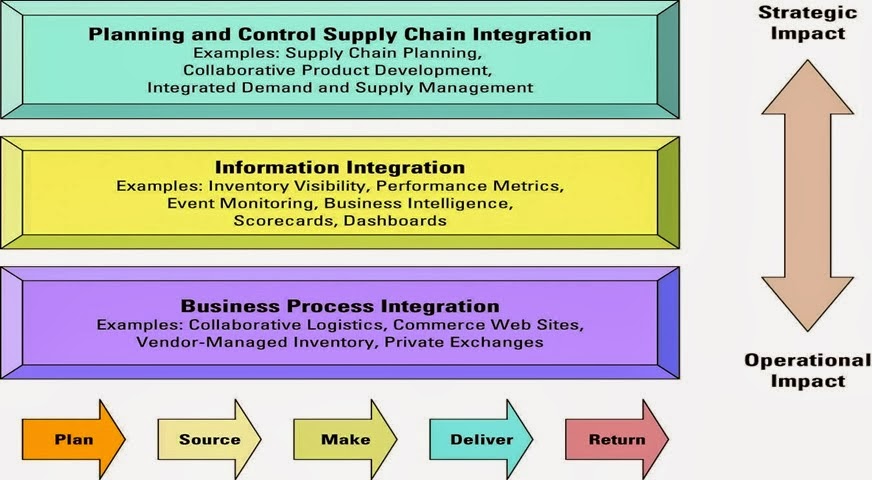
Integration between SCM, CRM, and ERP Applications


CHAPTER 11 : BUILDING A CUSTOMER -CENTRIC ORGANIZATION-CUSTOMER MANAGEMENT

DEFINITION CRM :-
CRM is managing all aspects of customer’s relationship with an organization to increase customer loyalty and retention and organization’s profitability.

THE EVOLUTION OF CRM
· There are three phases in the evolution of CRM include reporting, analyzing, and predicting


This picture below shows the example of ugly side CRM


USING ANALYTICAL CRM TO ENHANCE DECISIONS


CHAPTER 10 : EXTENDING THE ORGANIZATION - SUPPLY CHAIN MANAGEMENT

Basics of supply chain


Information technology's role in the supply chain


factors driving scm :-


VISIBILITY
· Supply chain visibility – the ability to view all areas up and down the supply chain
· Bullwhip effect – occurs when distorted product demand information passes from one entity to the next throughout the supply chain


CONSUMER BEHAVIOUR
· Companies can respond faster and more effectively to consumer demands through supply chain enhances
· Demand planning software – generates demand forecasts using statistical tools and forecasting techniques

COMPETITION
· Supply chain planning (SCP) software– uses advanced mathematical algorithms to improve the flow and efficiency of the supply chain
· Supply chain execution (SCE) software – automates the different steps and stages of the supply chain

SPEED


SUPPLY CHAIN MANAGEMENT SUCCESS FACTORS
-there have 7 principles of scm.


CHAPTER 9 : ENABLING THE ORGANIZATION - DECISION MAKING

The decision making proses :-

  • problem identification
  • data collection 
  • solution generation
  • solution test
  • solution selection
  • solution implementation


operational
-employees develop, control and maintain core business activities required to run the day-to-day operations.

managerial
-employees continuously evaluating company operations to hone the firm's abilities to identify, adapt to, and   leverage change.

strategic
-managers develop overall business strategies, goals, and objectives as part of the company's strategic plan.


       Artifical Intelligence:
·         AI simulates human thinking and behaviour, such as the ability to reason and learn.
·         Its ultimate goal is to build a system that can mimic human intelligence.
·         Its increase the speed and consistency of decision making
·         Solve problems with incomplete information and etc.


Thursday, 6 February 2014

CHAPTER 8 : ACCESSING ORGANIZATIONAL INFORMATION - DATA WAREHOUSE

Data warehouse fundamentals

-Data warehouse - a logical collection of information-gathered from many different operational database- that supports business analysis activities and decision-making tasks.

-Primary purpose - to aggregate information throughout an organization into a single repository in such way that employees can make decisions and undertake business analysis activities.

-Extraction, transformation and loading (ETL) - a process that extracts information from internal and external database, transforms the information using a common set of enterprise definitions, and loads the information into a data warehouse.

-Data warehouse- then send subsets of the information to data mart.

-Data mart - contain the subsets of data warehouse information.


MULTIDIMENSIONAL ANALYSIS AND DATA MINING
cube- the common term for the representation of multi dimensional databases.


data mining - process of analyzing data to extract information not offered by the raw data alone.
data-mining tools - variety of techniques to find patterns and relationship in large volumes of information and infer rules from them that predict future behaviour decision making.

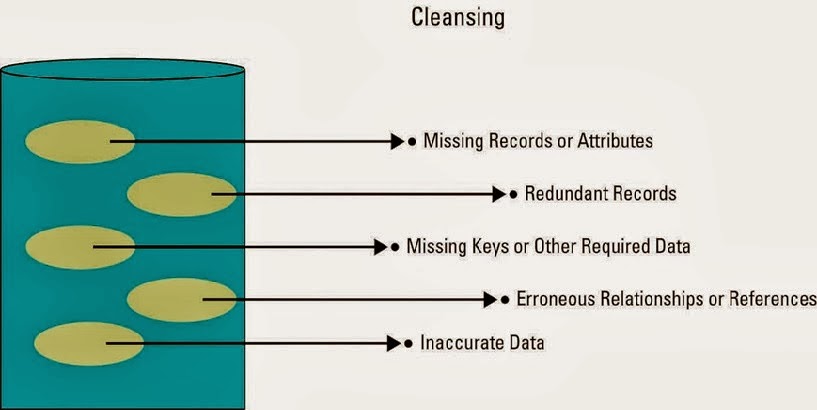
INFORMATION CLEANSING AND SCRUBBING

                                                -contact information in operational system

                                           -standardizing customer name from operational systems

                                                         -information cleansing activities


                                                       -accurate and complete information


BUSINESS INTELLIGENCE

-application and technologies that are used to gather, provide access to and analyze data and information to support decision-making efforts.specifically :-


  • collecting information.
  • discerning patterns and meaning in the information.
  • responding to the resultant information.


CHAPTER 7 : STORING ORGANIZATIONAL INFORMATION-DATABASES

Database - maintains information about various types of objects (inventory), events (transactions), people (employees), and places (warehouses).
Hierarchical database model - information is organized into a tree-like structure that allows repeating information using parent/child relationships in such a way that it cannot have too many relationships.
Network database model - is a flexible way of representing objects and their relationships.
Relational database model - type of database that stores information in the form of logically related two-dimensional tables.

This picture below show the hierarchical, network and relational structure :-


ENTITIES AND ATTRIBUTES
entity - the relational database ,model is a person, place, thing model is a person, place, thing, transaction, or event about which information is stored.
attributes - fields or columns, are characteristics or properties of an entity class.

KEYS AND ATTRIBUTES
primary key - group and fields that uniquely identifies a given entity in a table.
foreign key -  the relational database model is a primary key of one table that appears as an attribute in another table and acts to provide a logical relationship between two tables.


RELATIONAL DATABASE ADVANTAGES
-Increased flexibility
-Increased scalability and performance
-Reduced information redundancy
-Increased information integrity (quality)
-Increased information security

#INCREASED FLEXIBILITY
Databases tend to mirror business structures and a good database can handle changes quickly and easily.
physical view - information deals with the physical storage of information on a storage device such as a hard disc.
logical view - information focuses on how users logically access information to meet their particular business needs.

#INCREASED SCALABILITY AND PERFORMANCE
scalability - how well a system can adapt to increased demands.
performance - how quickly system performs a certain process or transaction.

#REDUCED INFORMATION REDUNDANCY
redundancy - duplication of information, or storing the same information in multiple places.

#INCREASED INFORMATION INTEGRITY (QUALITY)
information integrity - measure of the quality of information.
relational integrity constraints - rules that enforce basic and fundamental information- based constraints.
business-critical integrity constraints - enforce business rules vital to an organization's success an often require more insight and knowledge than relational integrity constraints.

#BUSINESS INFORMATION SECURITY
any asset that the organization must protect its information from unauthorized users or misuse.

DATABASE MANAGEMENT SYSTEMS (DBMS)
-software through which users and application programs interact with a database.


DATA DRIVEN WEBSITE
-interactive website kept constantly updated and relevant to the needs of its customers through the use of a database.


INTEGRATING INFORMATION AMONG MULTIPLE DATABASES
integration - allows separate systems to communicate directly with each other.
forward integration - takes information entered into a given system and sends it automatically to all downstream systems and processes.
backward integration - takes information entered into a given systems and sends it automatically to all upstream systems and processes.